
Does Building Muscle Actually Protect Your Bones After Menopause?
The short answer is that muscle and bone are closely connected partners. They support each other, they respond to many of the same signals, and strong muscle is one of the ways your skeleton is told to stay strong. So when a woman asks me whether building muscle protects her bones, I tell her that the honest answer is more interesting than a simple yes.
Let me walk you through what is actually happening, because this is one of the most important things a woman can understand about her body after menopause.
How Are Muscle and Bone Connected?
Your bones are not static scaffolding. Bone is living tissue that is constantly being broken down and rebuilt, and it decides how much of itself to keep based on the demands placed on it. Muscle is one of the main sources of that demand, which is why the two are so closely connected.
The primary demand is force. When muscle contracts, it pulls on the bone it attaches to, and that pull is one of the strongest signals bone receives. Bone reads the load and responds by maintaining or building density where it is needed. This principle has a name in medicine. It is called Wolff's law, and the system that regulates it is often described as the mechanostat: bone that is loaded holds its density, and bone that is unloaded gives it up.
This is why astronauts lose bone in the absence of gravity, and why prolonged bed rest thins the skeleton. Bone keeps what it is asked to use.
The practical meaning is direct. Strong, active muscle is one of the ways your skeleton is told to stay strong. When muscle weakens, one of the important signals to maintain bone weakens with it.

Why Does Menopause Affect Both at Once?
Here is where estrogen matters, and where women deserve a clear and accurate explanation.
The relationship between estrogen and bone is well established. Estrogen helps restrain the cells that break bone down, so when it declines around menopause, bone loss can accelerate. This is one of the most firmly documented changes of the menopausal transition.
Muscle is a more complex story. Skeletal muscle also changes with age, and estrogen appears to play a role in muscle maintenance, but the relationship is less direct and less fully understood than the one between estrogen and bone. What we can say is that many women notice changes in muscle and bone in the same season of life, and that the two tissues are closely linked in how they support each other.
The medical terms are sarcopenia for age-related muscle loss and osteoporosis for bone loss. They frequently appear together, and researchers use the term osteosarcopenia for the two occurring at once, because they share so much biology.
Why Strength and Balance Are the Real Longevity Story
It would be easy to make this only about bone density on a scan. The deeper story is about what those numbers protect you from.
The serious event in later life is a fracture, and most fractures happen in a fall. What protects a woman from that outcome is not bone density alone. It is the combination of a skeleton that has kept its strength and a body that does not fall in the first place.
Muscle governs the second half of that equation. Strength, balance, coordination, and the ability to catch yourself are all functions of working muscle, particularly the muscle of your core and your center of gravity. A strong center keeps you steady on uneven ground, on stairs, stepping off a curb in the dark.
When I talk with women about muscle, this is what I am thinking about. Not a number. Whether she is still walking confidently, traveling, lifting a grandchild, and living without the fear of a fall narrowing her world. That is what longevity actually means. Not only years, but the strength to use them.
Where Emsculpt Neo Fits
I want to be precise here, because precision is the whole point.
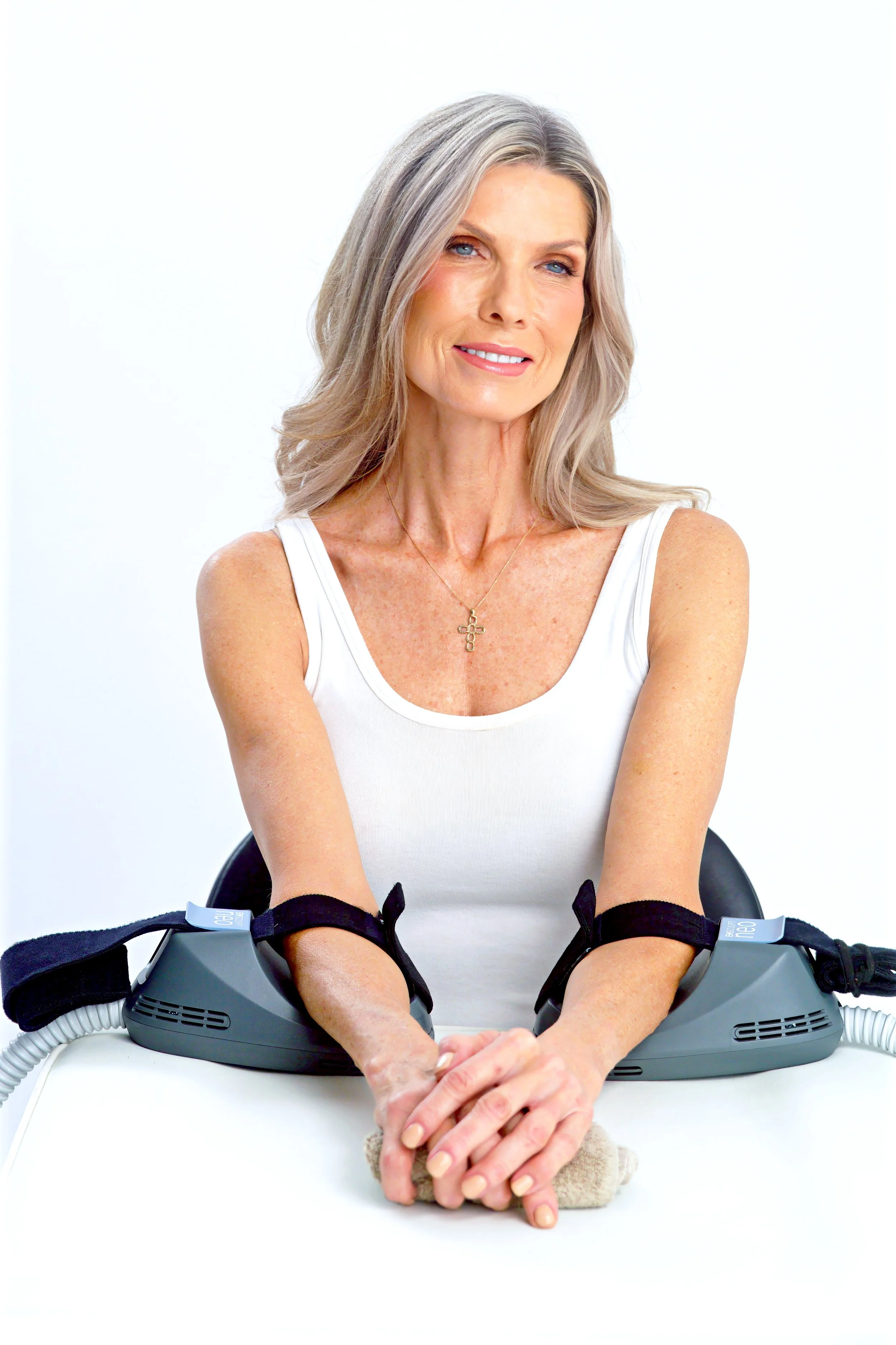
Emsculpt Neo is a treatment for muscle. It combines high-intensity focused electromagnetic energy, known as HIFEM, with radiofrequency, and it triggers supramaximal muscle contractions that voluntary exercise cannot replicate. It is designed to strengthen the core, the abdomen, and the glutes, the muscle at your center of gravity.
What it does is build and reinforce muscle. It is not a treatment for bone, and I would be cautious of anyone who tells you a device rebuilds your skeleton. What muscle offers your bones is the loading and the strength and the balance we have been talking about, and muscle is the input most within your reach.
While we cannot stop the hormonal changes that come with menopause, we can support the muscle that helps protect the body through them. Emsculpt Neo is one tool for that, and it works best alongside a healthy lifestyle, weight-bearing movement, good nutrition, and the bone care your physician recommends. It complements that foundation. It does not replace it.
What This Means for You
If you take one thing from this, let it be that muscle is not only about how you look or even only about how you feel today. It is one of the levers you have for how strong and independent you remain for decades.
I am a woman in my fifties. I have gone through this. I think about my own strength the same way I ask my patients to think about theirs, as an investment that pays out slowly, over a long and active life.
Ready to Get Started?
If you would like to schedule an Emsculpt Neo treatment, or find out whether it is right for you, call our office at (805) 870-4487 or send us a message through ourcontact page and we will reply within 24 business hours. Already a patient? You can add Emsculpt Neo to your next visit.
