
How Do I Know Where My Filler Is? The Case for Aesthetic Ultrasound
Here is a question I hear more and more, and I love that people are asking it: how do you actually know where my filler is, or where a new injection is going?
For a long time, the honest answer across the field was that injectors relied on surface anatomy, experience, and a deep knowledge of where structures usually sit. That knowledge matters and it always will. But every face is different, and blood vessels do not always run exactly where the textbook says. Aesthetic ultrasound changes what is possible, because it lets me see beneath the skin rather than relying on the surface alone.
Let me explain what that actually means for you.
What Is Aesthetic Ultrasound?
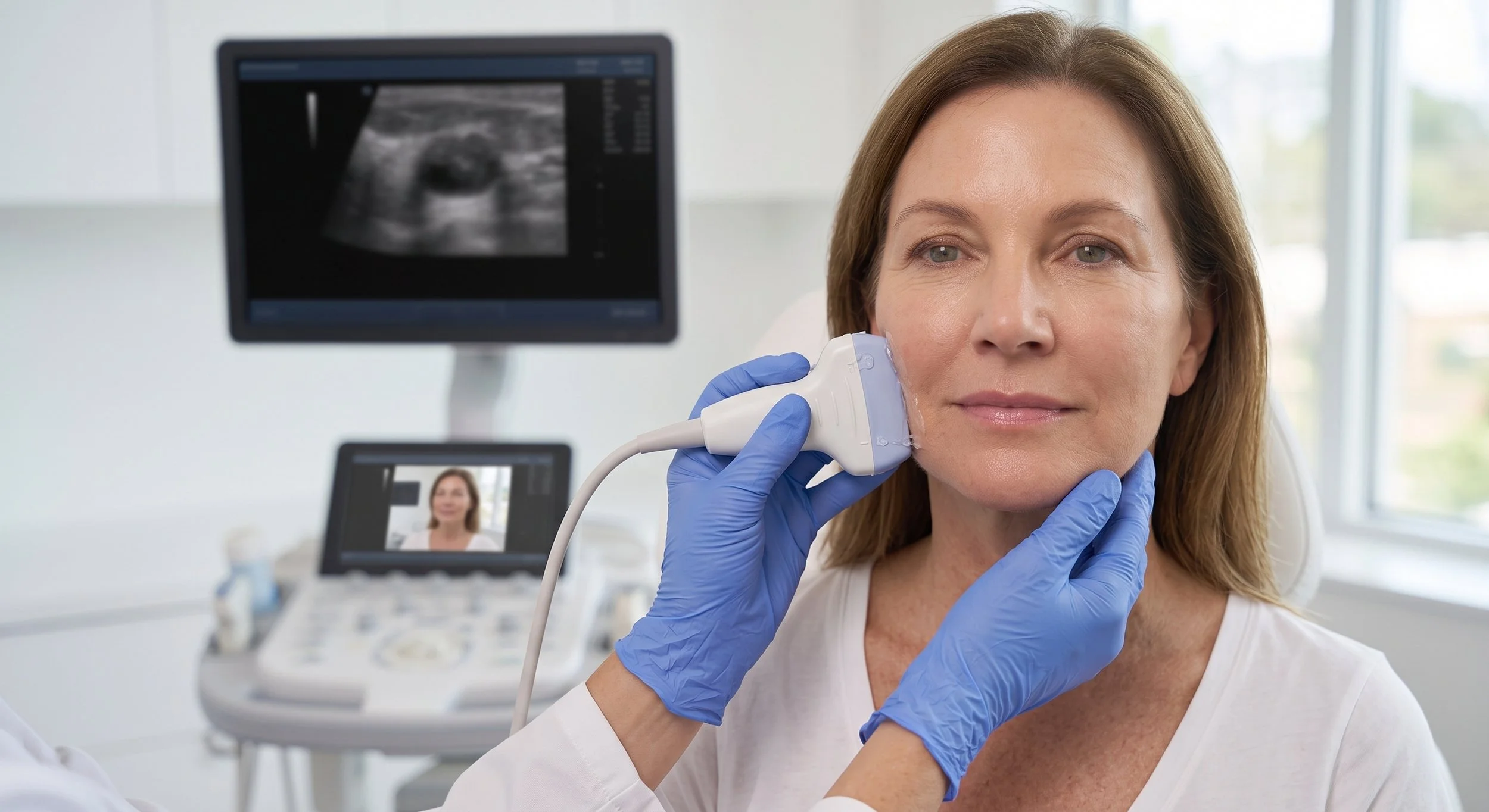
Aesthetic ultrasound uses high-frequency sound waves to create a real-time image of the structures beneath your skin. It is the same fundamental technology used throughout medicine to look inside the body safely, applied here specifically to the face and to aesthetic injections.
It involves no radiation and no discomfort. A small handheld probe glides over the skin with a little gel, and the image appears in real time. To be clear about my scope, I use ultrasound for aesthetic purposes, to guide and refine injectable treatments. I do not use it to diagnose or treat medical disease.
What it gives me is sight. Instead of working from the surface and from anatomical averages, I can see your particular anatomy, on the day, in the moment.
What Can Ultrasound Actually Show?
This is where it becomes practical. Here is what I can see and do with ultrasound in my practice.
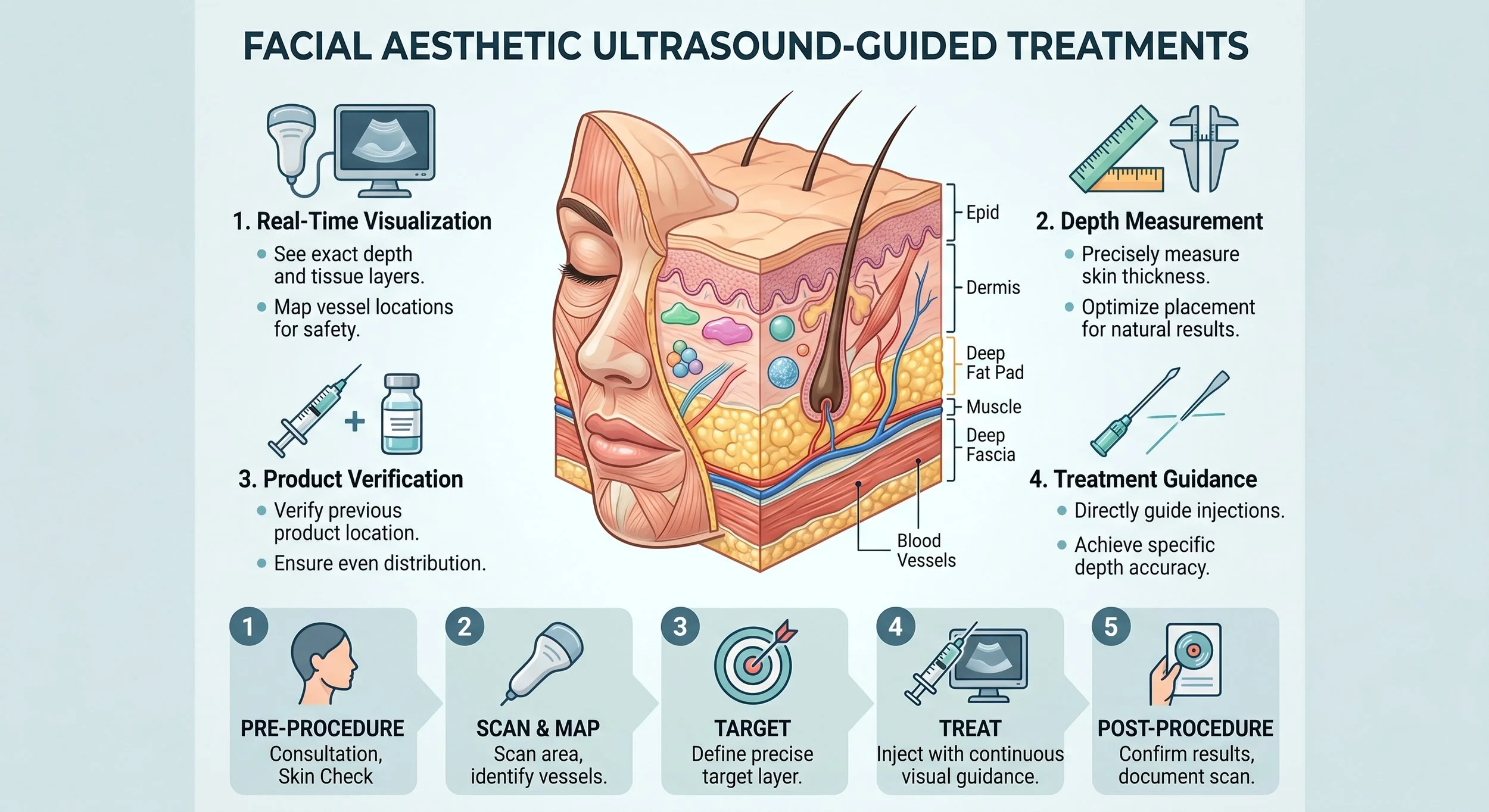
Your facial anatomy and blood vessels. I can visualize the vessels and tissue beneath the skin before I ever place a needle. The most serious risks in filler injection involve blood vessels, so being able to map exactly where yours run is one of the most meaningful safety advances the field has seen.
The tissue plane and depth. Filler behaves differently depending on the exact layer it sits in. Ultrasound lets me see the plane and choose the correct depth for what we are trying to achieve, rather than estimating it.
Existing or old filler. Many patients genuinely do not know what they have had, where it was placed, or how much remains. Ultrasound can identify existing filler, including product from years ago and from other injectors, so we are never guessing about what is already there.
The placement and spread of new filler. As filler goes in, I can watch where it settles and how it distributes, which supports a more even, intentional result.
Possible filler migration. Filler can sometimes move from where it was originally placed. Ultrasound lets me see whether that has happened and where the product has traveled, which is often impossible to determine from the surface alone.
Why This Matters for Safety
The reason I invested in this is safety, and I want to be straightforward about it.
The most serious complication in filler injection is placing product into or against a blood vessel. Mapping your vessels first, and in some cases watching in real time as I work, allows me to navigate your anatomy and reduce that risk. No responsible physician will ever promise that any procedure is risk-free. What I can tell you is that seeing your anatomy is a meaningful improvement over not seeing it, and the medical literature increasingly supports ultrasound as a tool for safer aesthetic injection.
There is also a quieter benefit. When I can see the depth, the plane, and what is already there, I can be more precise and more intentional, which supports a more natural result.
Finding and Dissolving Old Filler
This deserves its own moment, because it is one of the most useful things ultrasound allows, and one of the most searched.
If you have had filler in the past and are unhappy with it, or you are not sure what you have, ultrasound can help locate it. And when filler needs to be dissolved, ultrasound allows me to target the specific deposit precisely, rather than treating a general area and hoping. That means dissolving what needs to go while preserving the surrounding structure and your desired result.
For anyone who has felt stuck with old work they did not love, this is genuinely good news.
The Simple Idea at the Center
Everything here comes back to one idea. Aesthetic ultrasound lets me see what is beneath the skin rather than relying on surface anatomy alone. Sight leads to precision, precision supports safety, and safety is the foundation everything else is built on.
I believe this is where careful, physician-led aesthetic medicine is going, and it is how I choose to practice.
Ready to Get Started?
If you would like to schedule an ultrasound-guided treatment, or find out whether it is right for you, call our office at (805) 870-4487 or send us a message through our contact page and we will reply within 24 business hours. Already a patient? You can add it to your next visit.
